Coldcard Mk4 vs. Trezor Safe 3: Secure Element, Air-Gap & PSBT Engineering Audit
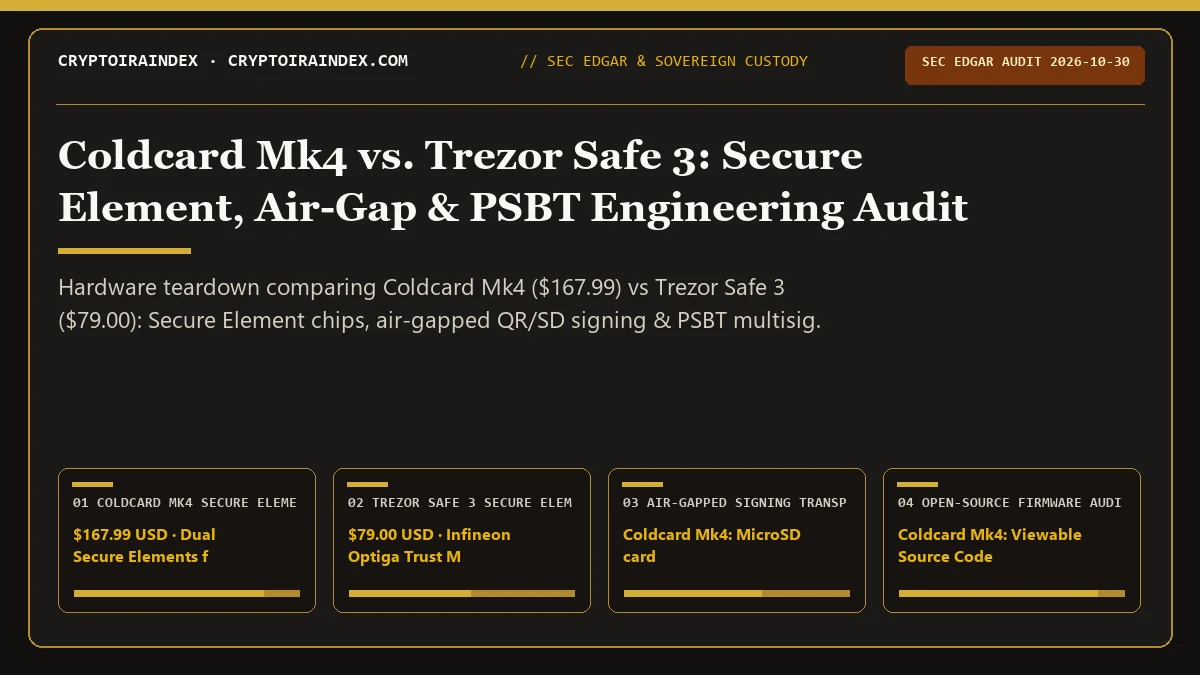
Component-level teardown comparing Coinkite Coldcard Mk4 ($167.99) against Trezor (SatoshiLabs) Trezor Safe 3 ($79.00).
Coldcard Mk4 ($167.99): Dual Secure Elements from 2 independent manufacturers: Microchip ATECC608B + Maxim DS28C36B (plus STM32L4S5 MCU) · Air-Gapped.
Trezor Safe 3 ($79.00): Infineon Optiga Trust M V3 (CC EAL6+ certified, NDA-free) · USB/BLE.
Side-by-Side Hardware Engineering Matrix: Coldcard Mk4 vs. Trezor Safe 3
| Hardware Specification | Coldcard Mk4 ($167.99) | Trezor Safe 3 ($79.00) |
|---|---|---|
| Manufacturer & Origin | Coinkite (Canada (Toronto, ON — ships direct to US)) | Trezor (SatoshiLabs) (Czech Republic (US warehouse distribution available)) |
| Secure Element Chip | Dual Secure Elements from 2 independent manufacturers: Microchip ATECC608B + Maxim DS28C36B (plus STM32L4S5 MCU) | Infineon Optiga Trust M V3 (CC EAL6+ certified, NDA-free) |
| Air-Gap Signing Transport | MicroSD card (PSBT signing), NFC tap (BIP-174 PSBT & address share), Virtual Disk USB mode optional (can be permanently disabled via physical PCB trace cut) | Not air-gapped (USB-C connection) |
| Display & Input | 128x64 OLED screen + physical numeric keypad + Genuine/Caution green/red verification LEDs connected directly to the Secure Element | 0.96-inch 128x64 monochromatic OLED display + 2 physical confirmation buttons |
| Power Architecture | USB-C power bank / wall adapter (no internal battery to degrade) | USB-C (no internal battery) |
| Open-Source Auditability | Viewable Source Code (MIT + Coinkite Commons Clause; reproducible builds via Docker) | 100% Open-Source Firmware & Hardware (GPLv3) |
| PSBT & Multisig Support | Industry benchmark for native BIP-174 PSBT, P2WSH, P2TR (Taproot), BIP-85 deterministic child seeds, Seed XOR, Duress PINs, Brick-Me PIN, and Trick PINs | Full PSBT, Taproot, SLIP-39 20-word backup & BIP-39, ideal low-cost hardware cosigner for 2-of-3 Sparrow/Unchained/Casa multisig vaults |
| US Supply-Chain Security | Shipped in serialized, tamper-evident Coinkite security bag; factory pre-bag number is cryptographically committed inside the Secure Element and verified on first boot. | Best sub-$80 entry point with a genuine EAL6+ Secure Element and open-source firmware. |
- 01Coldcard Mk4 Secure Element & Price
- $167.99 USD · Dual Secure Elements from 2 independent manufacturers: Microchip ATECC608B + Maxim DS28C36B (plus STM32L4S5 MCU)
- 02Trezor Safe 3 Secure Element & Price
- $79.00 USD · Infineon Optiga Trust M V3 (CC EAL6+ certified, NDA-free)
- 03Air-Gapped Signing Transport
- Coldcard Mk4: MicroSD card (PSBT signing), NFC tap (BIP-174 PSBT & address share), Virtual Disk USB mode optional (can be permanently disabled via physical PCB trace cut) | Trezor Safe 3: Not air-gapped (USB-C connection)
- 04Open-Source Firmware Auditability
- Coldcard Mk4: Viewable Source Code (MIT + Coinkite Commons Clause; reproducible builds via Docker) | Trezor Safe 3: 100% Open-Source Firmware & Hardware (GPLv3)
- 05PSBT & 2-of-3 Multisig Support
- Coldcard Mk4: Industry benchmark for native BIP-174 PSBT, P2WSH, P2TR (Taproot), BIP-85 d | Trezor Safe 3: Full PSBT, Taproot, SLIP-39 20-word backup & BIP-39, ideal low-cost hardwar
- 06Ongoing Annual Custody Drag
- $0.00 / yr on both devices (100% sovereign self-custody; zero ETF AUM drag)
How Do Costs, Fees & 10-Year Total Ownership Drag Compare Between Coldcard Mk4 and Trezor Safe 3?
When comparing Coldcard Mk4 against Trezor Safe 3 across a 10-year self-custody horizon, investors shift from recurring percentage-based AUM fees (like the 0.15%–0.25%/yr charged by Spot ETFs) to fixed capital expenditure (CapEx) plus on-chain Bitcoin network miner fees (`sat/vB`). On a $1,000 portfolio, purchasing Coldcard Mk4 ($167.99 upfront) or Trezor Safe 3 ($79.00 upfront) plus a $39 stamped 316 marine stainless steel seed backup represents a one-time setup cost, with $0.00/yr in ongoing management drag. On a $10,000 allocation held for 10 years at 10% CAGR, a 0.25% Spot ETF drains $615 in compounding sponsor fees, whereas both Coldcard Mk4 and Trezor Safe 3 charge $0 in percentage AUM fees. Scaling to a $100,000 sovereign vault over 10 years, self-custody saves $6,150+ in avoided ETF management fees (or $38,200+ on a $500,000 treasury), even when factoring in a multi-vendor 2-of-3 quorum or collaborative inheritance subscription.
Beyond hardware acquisition cost, long-term total cost of ownership depends on Bitcoin script weight and UTXO management. Both Coldcard Mk4 and Trezor Safe 3 support Native SegWit (`P2WPKH`, BIP-84, ~68 vBytes per input) and Taproot (`P2TR`, BIP-86, ~57.5 vBytes per input), while a 2-of-3 multisig input (`P2WSH` / `P2TR` script path) consumes ~105 vBytes. Using our Live Bitcoin UTXO Consolidation Calculator, consolidating small DCA inputs when mempool rates sit at 2–5 sat/vB (<$1.00 per transaction) prevents paying $100+ in network fees during bull-market mempool spikes.
How Do Custody Architecture, Counterparty Risk & Regulatory Oversight Differ?
From a cryptographic hardware and threat-modeling standpoint, Coldcard Mk4 and Trezor Safe 3 take distinct approaches to isolating private keys from internet-connected host malware, supply-chain interdiction, and physical laboratory extraction (voltage glitching, laser fault injection, and differential power analysis). By removing third-party omnibus custodians entirely, self-custody eliminates the counterparty insolvency risk that caused $21.19 billion in historical losses across 1,328 incidents tracked in our Crypto Hacks & CEX Exploits Database and landmark collapses like FTX, Celsius, and Voyager.
Even more importantly, institutional security engineers never treat Coldcard Mk4 and Trezor Safe 3 as mutually exclusive: in a 2-of-3 multi-vendor multisig vault coordinated via Sparrow Wallet, Unchained, Casa, or Nunchuk, combining independent hardware architectures (for example, pairing an air-gapped QR/MicroSD signer with an open-source EAL6+ signer from a second manufacturer) ensures that no single chip vulnerability, supply-chain defect, or firmware bug can ever compromise or freeze your vault.
What Are the US Tax, Wash Sale (IRC § 1091) & Estate Inheritance (RUFADAA / IRC § 1014) Differences?
Holding digital assets directly via Coldcard Mk4 or Trezor Safe 3 unlocks three critical US statutory advantages—and imposes two mandatory compliance responsibilities—under IRS and state fiduciary law:
- IRS Notice 2014-21 Property Status vs. IRC § 1091 Wash Sales: Direct spot Bitcoin and Ethereum held in self-custody are classified as property under
IRS Notice 2014-21, not securities underIRC § 1091, giving taxable self-custody holders flexibility during tax-loss harvesting that Spot ETFs (`IBIT`/`FBTC`/`ETHA`) lack. - Rev. Proc. 2024-28 Wallet-by-Wallet Cost Basis Tracking: Starting January 1, 2025, the IRS eliminated universal cross-wallet pooling. Under
Rev. Proc. 2024-28andTreas. Reg. § 1.1012-1(j), taxpayers must maintain specific unit allocations and cost-basis lots separately for each hardware wallet or multisig vault, while self-to-self UTXO consolidations remain non-taxable transfers of principal. - RUFADAA Estate Succession & IRC § 1014 Step-Up in Basis: When self-custodied crypto is titled inside a Revocable Living Trust (RLT) with explicit RUFADAA fiduciary authorization and a documented Letter of Instruction (or Miniscript timelock / collaborative 2-of-3 inheritance protocol), heirs bypass public probate court and receive a 100% tax-free step-up in cost basis to date-of-death Fair Market Value under IRC § 1014(a).
Investor Scenario Decision Matrix: Should You Choose Coldcard Mk4 or Trezor Safe 3 in 2026?
| Self-Custody Persona & Threat Model | Primary Engineering Requirement | Recommended Winner | Technical & Operational Rationale |
|---|---|---|---|
| 1. Air-Gapped Cold Vault Maximalist ($50k–$1M+) | Zero physical USB data connection to host PC | Coldcard Mk4 | Optical QR (`BBQr`/`UR 2.0`) or MicroSD PSBT signing isolates private keys completely from host OS malware and USB stack exploits. |
| 2. 2-of-3 Multi-Vendor Quorum Architect | Eliminate single-vendor silicon & firmware monoculture | Combine Both (Coldcard Mk4 + Trezor Safe 3) | Using Coldcard Mk4 as Key 1 and Trezor Safe 3 as Key 2 inside Sparrow Wallet guarantees zero single point of failure. |
| 3. Cost-Conscious DCA Accumulator ($1k–$25k) | Maximum cryptographic security per dollar of CapEx | Trezor Safe 3 | Delivers institutional-grade key isolation at the lower upfront acquisition cost, leaving more capital for spot accumulation. |
| 4. Estate & RUFADAA Trust Executor Setup | Guided heir recovery without exposing live seed phrases | Coldcard Mk4 in 2-of-3 Vault | Pairs cleanly with a Revocable Living Trust and BIP-380 Output Descriptor backups for seamless IRC § 1014 transfer. |
| 5. Collaborative 2-of-3 Multisig IRA Holder | McNulty-compliant retirement key control (IRC § 408) | Coldcard Mk4 + Trezor Safe 3 | Both serve as verified hardware cosigners inside Unchained IRA and Choice by Kingdom Trust retirement vaults. |
| 6. Active Web3 / Multi-Chain DeFi Operator | Strict Tier-1 Cold Vault vs Tier-2 Hot Wallet separation | 2-Device Tiered Segregation | Keep 95% of net worth on a zero-approval cold signer (Zero Permit2 exposure) and use a separate signer for active DeFi. |
Frequently Asked Questions (SEC, IRS & Custody Engineering)
Coldcard Mk4 uses Dual Secure Elements from 2 independent manufacturers: Microchip ATECC608B + Maxim DS28C36B (plus STM32L4S5 MCU), whereas Trezor Safe 3 uses Infineon Optiga Trust M V3 (CC EAL6+ certified, NDA-free).
Yes! Combining Coldcard Mk4 (Coinkite) and Trezor Safe 3 (Trezor (SatoshiLabs)) as separate cosigners in Sparrow Wallet, Unchained, or Casa eliminates single-manufacturer supply-chain and firmware risk.
For Coldcard Mk4 vs Trezor Safe 3, investors must compare compounding percentage-based expense ratios (0.15% to 0.25% per year in US Spot ETFs, which equals $382 per $10,000 or $3,820 per $100,000 over 10 years at 10% CAGR) against one-time hardware self-custody CapEx ($79–$249 with $0/yr ongoing management fee) or flat-fee 2-of-3 multisig retirement vaults.
SEC-registered Spot Bitcoin and Ethereum ETFs (such as IBIT, FBTC, BTC Mini, and ETHA) and public crypto equities (MSTR, COIN) are securities strictly governed by the 30-day IRC § 1091 Wash Sale Rule. Direct spot cryptocurrency held in self-custody is treated as property under IRS Notice 2014-21 and requires wallet-by-wallet cost-basis lot accounting under Rev. Proc. 2024-28.
Institutional risk management for Coldcard Mk4 vs Trezor Safe 3 requires auditing whether underlying keys sit inside an omnibus NYDFS trust custodian (such as Coinbase Custody Trust, Fidelity Digital Assets, or Gemini Trust) or inside a sovereign EAL6+/dual-chip air-gapped hardware signer (Coldcard Q, Trezor Safe 5, BitBox02) arranged in a multi-vendor 2-of-3 quorum.
Receive verified institutional dispatches covering SEC S-1/19b-4 fee amendments, IRS Form 1099-DA / 5498 rulings, and CA DFPI / SEC PAUSE enforcement dockets.