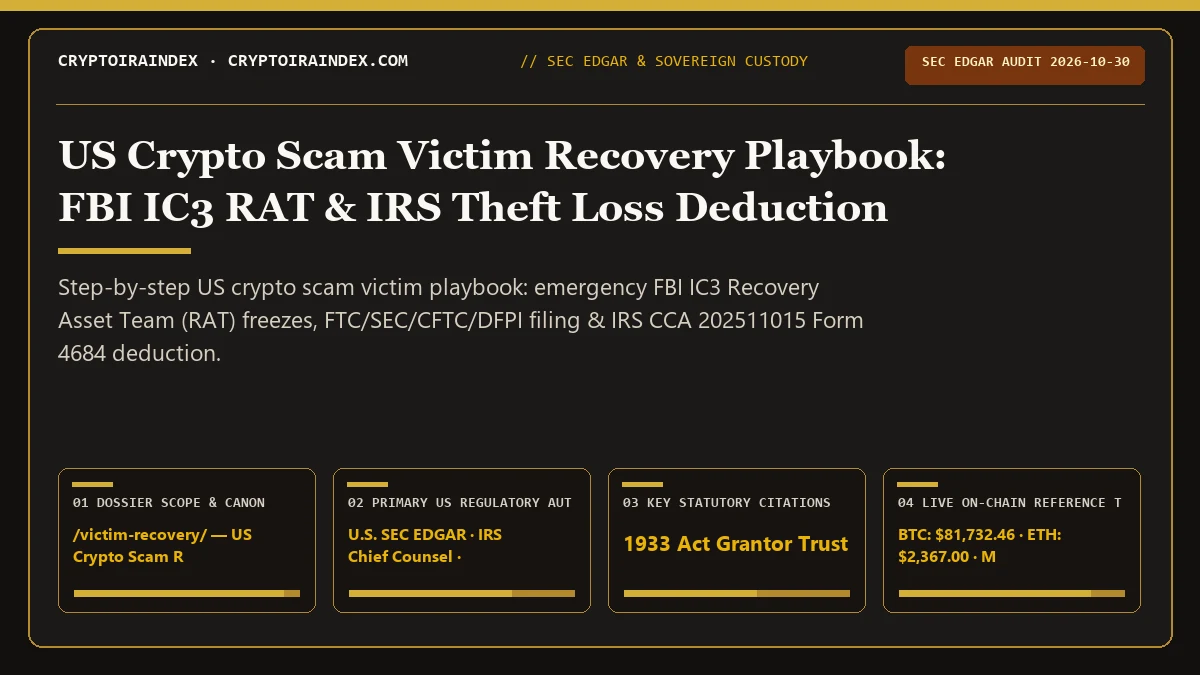
US Crypto Scam Victim Recovery Playbook: FBI IC3 RAT & IRS Theft Loss Deduction
If you or a client have lost funds to a Pig Butchering platform, wallet drainer, or fraudulent exchange, execute this two-step federal protocol immediately: (1) file an emergency law-enforcement freeze request with the FBI IC3 Recovery Asset Team (RAT) within 24–72 hours, and (2) document your transaction-for-profit theft loss under IRS Chief Counsel Advice CCA 202511015 (IRC § 165(c)(2) / Form 4684 Section B).
CRITICAL FEDERAL WARNING (FBI / FTC / DFPI): No legitimate government agency (IRS, FBI, SEC, CFTC, FinCEN) or blockchain analytics firm (Chainalysis, TRM Labs, Elliptic) will EVER contact a victim via WhatsApp, Telegram, Instagram, or email offering to 'hack back' or 'recover' stolen crypto for an upfront fee, tax payment, or smart-contract activation deposit. 100% of upfront-fee 'crypto recovery agents' are secondary advance-fee scammers.
Step 1: File Official Federal & State Law Enforcement Reports
FBI Internet Crime Complaint Center (IC3) & Recovery Asset Team (RAT)
Official Filing Portal →Jurisdiction: Federal Law Enforcement (Cyber Fraud, Pig Butchering, Ransomware, Wallet Drainers, Wire/Crypto Theft)
When to File: IMMEDIATELY (ideally within 24 to 72 hours of the fraudulent wire or crypto transfer). The FBI IC3 Recovery Asset Team (RAT) acts as a direct liaison with FinCEN, domestic banks, and centralized stablecoin issuers (Tether/USDT and Circle/USDC) to initiate emergency asset freezes if funds are still sitting in a custodial exchange or freezeable stablecoin contract.
- Exact Transaction Hashes (TXIDs) in plain text (not just screenshots)
- Victim sending wallet address and Scammer receiving wallet address + blockchain network (BTC, ETH, Tron TRC-20, Solana)
- All domains, WhatsApp/Telegram phone numbers, handles, and email headers used by the perpetrator
- Bank wire instructions, SWIFT/ABA routing numbers, and custodial exchange deposit receipts
Federal Trade Commission (FTC)
Official Filing Portal →Jurisdiction: Federal Consumer Protection (Imposter Scams, Romance Scams, Fake Crypto Giveaways, Bitcoin ATM Fraud)
When to File: File for all consumer fraud incidents. Reports enter the FTC Consumer Sentinel Network, accessible to over 2,800 federal, state, and local law enforcement agencies.
- Scam website URL, platform name, payment method (Crypto ATM, wire, gift card, stablecoin), and total USD loss.
U.S. Securities and Exchange Commission (SEC) — Tips, Complaints, and Referrals
Official Filing Portal →Jurisdiction: Federal Securities Enforcement (Unregistered Token Offerings, Ponzi Schemes, Fraudulent Yield/Staking Programs, Broker Impersonators)
When to File: File when a platform solicits investment in fraudulent securities, unregistered crypto investment pools, or appears on the SEC PAUSE list.
- Marketing materials, promised ROI claims, website URLs, and corporate entity names.
Commodity Futures Trading Commission (CFTC) — Division of Enforcement
Official Filing Portal →Jurisdiction: Federal Derivatives & Spot Commodity Fraud (Fraudulent Bitcoin/Crypto Forex/Margin Platforms, Pig Butchering Signal Groups, RED List Entities)
When to File: File when a scam involves leveraged crypto trading, fake futures/options apps, or commodity pool fraud.
- Trading dashboard URLs, MetaTrader/custom app names, deposit addresses, and chat logs.
California Department of Financial Protection and Innovation (DFPI)
Official Filing Portal →Jurisdiction: State Financial Regulator (California Digital Financial Assets Law — DFAL, Crypto Scam Tracker, Kiosk/ATM Fee Caps)
When to File: File to report new fraudulent crypto domains for public listing on the DFPI Crypto Scam Tracker and referral to the California DOJ.
- Scam domain URL, screenshots of fake withdrawal fee demands, and wallet addresses.
Step 2: IRS Tax Relief for Crypto Scam & Ponzi Victims: IRC § 165(c)(2) vs § 165(h)
Primary Statutory Authorities: IRC § 165(c)(2) (Losses incurred in any transaction entered into for profit, though not connected with a trade or business); IRC § 165(h) (Limitation on personal casualty and theft losses under § 165(c)(3) to Federally Declared Disasters); IRS Chief Counsel Advice CCA 202511015 (March 14, 2025 — Tax Treatment of Online Scam & 'Pig Butchering' Theft Losses); Rev. Rul. 2009-9 & Rev. Proc. 2009-20 (Ponzi Scheme Theft Loss Safe Harbor); IRS Form 4684, Section B (Casualties and Thefts — Income-Producing / Profit-Seeking Property). Official IRS Memorandum: https://www.irs.gov/pub/irs-wd/202511015.pdf.
| Scam / Loss Category | Deductible? | IRC Section | IRS Form | Statutory & CCA 202511015 Analysis |
|---|---|---|---|---|
| Pig Butchering / Fake Crypto Trading Platform / Fraudulent Liquidity Mining (Profit Motive Present) | Deductible (§ 165(c)(2)) | IRC § 165(c)(2) & IRS CCA 202511015 | Form 4684, Section B (Part I) -> Schedule A (Form 1040), Line 16 ('Other Itemized Deductions') | In CCA 202511015, the IRS Office of Chief Counsel ruled that when a victim transfers funds into a fabricated crypto investment platform with the objective of earning investment returns (profit motive), the resulting criminal theft is an investment theft loss under IRC § 165(c)(2) — NOT a personal theft loss under § 165(c)(3). Therefore, it is EXEMPT from the TCJA Federally Declared Disaster restriction, EXEMPT from the $100 / 10% AGI hair-cuts, and deducts against ordinary income in the year the fraud is discovered (provided there is no reasonable prospect of recovery). Deductible basis includes both the initial invested principal (cost basis) and bogus 'tax/withdrawal fees' paid to try to unlock the investment. |
| Multi-Investor Crypto Ponzi Scheme / Fraudulent Yield Platform with Indicted Lead Figure | Deductible (§ 165(c)(2)) | IRC § 165(c)(2), Rev. Rul. 2009-9 & Rev. Proc. 2009-20 Safe Harbor | Form 4684, Section B (Part II — Ponzi-Type Investment Schemes) -> Schedule A, Line 16 | When a lead figure of a fraudulent investment enterprise is criminally charged by federal or state indictment/information or SEC/CFTC receivership complaint, victims meeting Rev. Proc. 2009-20 may deduct 95% of their qualified net investment (if not pursuing third-party claims) or 75% (if pursuing third-party recovery) in the 'discovery year,' minus any actual cash/crypto bankruptcy distributions expected. |
| Pure Romance Gift Scam / Tech Support Impersonation / Seed Phrase Phishing of Personal Wallet (No Profit Motive) | Disallowed (§ 165(c)(3)) | IRC § 165(c)(3) & § 165(h)(5) | Not deductible on federal return while TCJA § 165(h) personal theft suspension applies | In CCA 202511015, the IRS contrasted profit-seeking scams with pure romance scams (sending gifts/medical money to a fictitious romantic partner) or phishing/kidnapping scams where the victim did not enter into an investment transaction for profit. Because those losses lack an IRC § 165(c)(2) profit motive, they fall under personal theft (§ 165(c)(3)) and are disallowed unless attributable to a Federally Declared Disaster. |
| Worthless / Rug-Pulled Token Still Held in Wallet vs Abandonment | Via taxable sale for pennies or IRC § 165 capital loss | IRC § 165(g) & CCA 202302011 | Form 8949 & Schedule D | Under IRS Chief Counsel Advice CCA 202302011, a cryptocurrency that merely drops 99.9% in price cannot be deducted as 'worthless' or 'abandoned' under IRC § 165(a) if it still trades for even a fraction of a cent or remains in the user's wallet. To lock in a capital loss on Form 8949, the taxpayer must actually dispose of the token in a closed and completed transaction (e.g., swapping it on a DEX or selling it for dust). |
- 01Dossier Scope & Canonical URI
/victim-recovery/— US Crypto Scam Recovery- 02Primary US Regulatory Authorities
- U.S. SEC EDGAR · IRS Chief Counsel · FinCEN · NYDFS · CA DFPI
- 03Key Statutory Citations
- 1933 Act Grantor Trust (WHFIT) · IRC §§ 1091, 1014, 408, 165(c)(2) · RUFADAA
- 04Live On-Chain Reference Telemetry
- BTC: $81,732.46 · ETH: $2,367.00 · Mempool Fast: 4 sat/vB
- 05Hardware & Multisig Benchmark
- CC EAL6+ Secure Element · Air-Gapped QR/MicroSD PSBT · 2-of-3 Quorum
- 06Verification & Audit Timestamp
- Independently verified against primary dockets on 2026-10-30
Quantitative Telemetry & Institutional Benchmark Visualization: US Crypto Scam Recovery
The inline telemetry chart below models verified cost, security, and regulatory parameters for US Crypto Scam Recovery as of :
How Do $1,000, $10,000 & $100,000 Capital Allocations Scale Under US Crypto Scam Recovery?
Institutional portfolio construction requires evaluating US Crypto Scam Recovery across concrete dollar thresholds rather than abstract percentages. On a starter allocation of $1,000, fixed operational expenses—such as a $79–$239.99 air-gapped hardware signer (Trezor Safe 3 or Coldcard Q) or a $250 annual collaborative multisig IRA fee—represent a higher initial percentage of principal, making zero-commission Spot ETFs like Grayscale Bitcoin Mini Trust (BTC, 0.15% TER = $1.50/yr per $1,000) or BlackRock IBIT (0.25% TER = $2.50/yr per $1,000) highly efficient entry vehicles. At the $10,000 portfolio tier, a 0.25% annual ETF expense ratio costs $25/yr ($382 compounded over 10 years at 10% CAGR), whereas a one-time $169 Trezor Safe 5 or $167.99 Coldcard Mk4 breaks even in Year 3 and charges $0.00/yr thereafter. At the $100,000 to $500,000+ institutional and family-office tier, compounding ETF sponsor drag reaches $3,820 to $19,100+ over a decade—making direct 2-of-3 multi-vendor hardware multisig or a flat-fee Unchained 2-of-3 IRA mathematically superior while eliminating single-custodian concentration at Coinbase Custody Trust.
Furthermore, on-chain network execution costs must be calibrated against current Bitcoin mempool conditions (currently 4 sat/vB at a reference price of $81,732.46/BTC). A single-signature Native SegWit (P2WPKH, BIP-84) spend of 141 virtual bytes costs approximately $0.46, a Taproot (P2TR, BIP-86) spend of 111 vBytes costs $0.36, and a 2-of-3 collaborative multisig spend of 205 vBytes costs $0.67. Proactive UTXO consolidation during low-fee windows ensures your long-term cold storage remains liquid even if network demand surges above 100 sat/vB.
What Are the SEC, IRS Tax (IRC §§ 1091, 1014, 408, 165) & RUFADAA Estate Rules for US Crypto Scam Recovery?
Every compliance decision surrounding US Crypto Scam Recovery intersects four pillars of United States federal and state law verified as of 2026-10-30:
- SEC 1933 Act Grantor Trust & WHFIT Tax Reporting: All 20 US Spot Bitcoin and Ethereum ETFs operate as Grantor Trusts under
Treas. Reg. § 1.671-5, issuing standard brokerageForm 1099-Band WHFIT statements rather than partnership Schedule K-1s. However, as registered securities, Spot ETFs are strictly subject to the 30-dayIRC § 1091Wash Sale Rule, whereas direct spot crypto held in self-custody is taxed as property underIRS Notice 2014-21with mandatory per-wallet cost-basis lot tracking underRev. Proc. 2024-28. - Retirement Account Qualification (IRC § 408 & McNulty v. Commissioner): Under McNulty v. Commissioner (157 T.C. No. 10), IRA owners cannot hold single-signature private keys or physical coins unsupervised at home via a Checkbook LLC without triggering a taxable distribution. Compliant retirement key control requires a regulated collaborative 2-of-3 multisig vault (Unchained IRA or Choice by Kingdom Trust) where a qualified custodian files
Form 5498andForm 1099-R. - Estate Succession (RUFADAA & IRC § 1014 Step-Up in Basis): Across 47+ US states, the Revised Uniform Fiduciary Access to Digital Assets Act (RUFADAA) governs fiduciary access. Titling Spot ETFs or self-custody multisig vaults inside a Revocable Living Trust (RLT) bypasses public probate court while preserving the 100% tax-free date-of-death cost-basis reset under IRC § 1014(a) and automatic long-term status under
IRC § 1223(9). - Federal Fraud Defense & IRS CCA 202511015 Theft Loss Relief: Cross-checking every domain and counterparty against our 1,049-Record Federal Scam Radar (CA DFPI, SEC PAUSE, CFTC RED, OFAC SDN) prevents Pig Butchering and Permit2 drainer losses. When profit-motivated investment fraud occurs, victims must file an emergency FBI IC3 Recovery Asset Team (RAT) freeze request within 24–72 hours and evaluate an investment theft loss deduction under
IRS CCA 202511015andIRC § 165(c)(2)on Form 4684 Section B.
Institutional Scenario & Compliance Matrix: US Crypto Scam Recovery (2026 Audit)
| Allocation Scenario & Investor Tier | Recommended Vehicle / Architecture | Annual Custody / Tax Drag | Primary Statutory & Security Control |
|---|---|---|---|
| 1. Tax-Free Brokerage Roth IRA ($5k–$100k) | BTC Mini (0.15%) / IBIT (0.25%) / FBTC (0.25%) | 0.15% – 0.25% TER ($0 Trade Fee) | 1933 Act Grantor Trust; 0% LTCG at age 59½+ under IRC § 408A |
| 2. Sovereign Cold Storage ($25k–$250k) | Coldcard Q or Trezor Safe 5 + 316 Steel Plate | $0.00 / yr ($79–$240 1x CapEx) | CC EAL6+ / Dual-SE isolation; Property under Notice 2014-21; Rev. Proc. 2024-28 |
| 3. Multi-Vendor 2-of-3 Quorum ($100k–$5M+) | Sparrow / Unchained / Nunchuk | $0 – $250 / yr Flat | Eliminates single-vendor hardware & seed risk; BIP-380 Output Descriptor backup |
| 4. Hold-Your-Own-Keys Retirement Rollover | Unchained IRA / Choice by Kingdom Trust | $250 / yr + 0.25%–1.00% Trade | Full McNulty v. Commissioner (157 T.C. 10) compliance + IRS Form 5498 |
| 5. Generational Estate Trust Succession | Revocable Living Trust + Miniscript Timelock | 100% Tax-Free Basis Reset | Bypasses public probate; full IRC § 1014(a) date-of-death FMV step-up |
| 6. Active Web3 / Operational Threat Defense | 2-Tier Cold/Hot Split + YubiKey FIDO2 | $0 Permit2 Cold Exposure | Zero dApp approvals on Tier-1 vault; 1,049-Record Scam Radar verification |
Frequently Asked Questions (SEC, IRS & Custody Engineering)
In CCA 202511015 (March 14, 2025), the IRS Office of Chief Counsel ruled that victims who transfer funds into a fraudulent crypto investment platform with an intent to earn a profit suffer an investment theft loss under IRC § 165(c)(2)—NOT a personal casualty/theft loss under § 165(c)(3). Therefore, those losses are deductible on Form 4684 Section B and Schedule A Line 16 without needing a Federally Declared Disaster.
Ideally within 24 to 72 hours of the fraudulent wire or crypto transaction, providing exact plain-text transaction hashes (TXIDs) and recipient wallet addresses so FBI RAT can coordinate emergency freezes with domestic banks, Tether (USDT), Circle (USDC), or custodial exchanges.
For US Crypto Scam Recovery, investors must compare compounding percentage-based expense ratios (0.15% to 0.25% per year in US Spot ETFs, which equals $382 per $10,000 or $3,820 per $100,000 over 10 years at 10% CAGR) against one-time hardware self-custody CapEx ($79–$249 with $0/yr ongoing management fee) or flat-fee 2-of-3 multisig retirement vaults.
SEC-registered Spot Bitcoin and Ethereum ETFs (such as IBIT, FBTC, BTC Mini, and ETHA) and public crypto equities (MSTR, COIN) are securities strictly governed by the 30-day IRC § 1091 Wash Sale Rule. Direct spot cryptocurrency held in self-custody is treated as property under IRS Notice 2014-21 and requires wallet-by-wallet cost-basis lot accounting under Rev. Proc. 2024-28.
Institutional risk management for US Crypto Scam Recovery requires auditing whether underlying keys sit inside an omnibus NYDFS trust custodian (such as Coinbase Custody Trust, Fidelity Digital Assets, or Gemini Trust) or inside a sovereign EAL6+/dual-chip air-gapped hardware signer (Coldcard Q, Trezor Safe 5, BitBox02) arranged in a multi-vendor 2-of-3 quorum.
Receive verified institutional dispatches covering SEC S-1/19b-4 fee amendments, IRS Form 1099-DA / 5498 rulings, and CA DFPI / SEC PAUSE enforcement dockets.