FBTC vs. GBTC (2026): Expense Ratio, Custodian, SEC Filings & Tax Audit
Head-to-head institutional comparison between Fidelity Wise Origin Bitcoin Fund (FBTC) and Grayscale Bitcoin Trust ETF (GBTC). Compare contractual sponsor fees (0.25% vs. 1.50%), cold-storage custodians, options chains, and IRC § 1091 wash sale rules.
Fee Comparison: FBTC carries an annual expense ratio of 0.25% ($25.00/$10k/yr) vs. 1.50% ($150.00/$10k/yr) for GBTC.
Custody Architecture: FBTC utilizes Fidelity Digital Asset Services, LLC (NYDFS-chartered Limited Purpose Trust Company — self-custodied within Fidelity), whereas GBTC utilizes Coinbase Custody Trust Company, LLC.
Side-by-Side SEC & Custodial Specification Matrix: FBTC vs. GBTC
| Specification | FBTC (Fidelity Investments) | GBTC (Grayscale Investments) |
|---|---|---|
| Full Legal Name | Fidelity Wise Origin Bitcoin Fund | Grayscale Bitcoin Trust ETF |
| Exchange & Ticker | Cboe BZX: FBTC | NYSE Arca: GBTC |
| SEC Central Index Key (CIK) | 0001852317 | 0001588489 |
| Primary Sector / Vehicle Type | Spot Crypto ETP (1933 Act Grantor Trust) | Spot Crypto ETP (1933 Act Grantor Trust) |
| Annual Management Fee (TER) | 0.25% ($25.00/$10k) | 1.50% ($150.00/$10k) |
| Custody / Balance Sheet Role | Fidelity Digital Asset Services, LLC (NYDFS-chartered Limited Purpose Trust Company — self-custodied within Fidelity) | Coinbase Custody Trust Company, LLC |
| Benchmark / Index Membership | Fidelity Bitcoin Reference Rate (FBTC Index) | CoinDesk Bitcoin Price Index (XBX) |
| Options Availability | Cboe / NASDAQ / NYSE Options | NYSE Arca / Cboe / NASDAQ Options |
| Tax Reporting Structure | Grantor Trust (1933 Securities Act) — Issues Form 1099-B + Annual WHFIT (Widely Held Fixed Investment Trust) Tax Information Statement (No Schedule K-1) | Grantor Trust (1933 Securities Act) — Issues Form 1099-B + Annual WHFIT (Widely Held Fixed Investment Trust) Tax Information Statement (No Schedule K-1) |
| IRC § 1091 Wash Sale Rule | Subject to IRC § 1091 Wash Sale Rule (regulated exchange-traded security; repurchasing identical or substantially identical ETF shares within 30 days before/after a loss sale disallows the loss deduction) | Subject to IRC § 1091 Wash Sale Rule (regulated exchange-traded security; repurchasing identical or substantially identical ETF shares within 30 days before/after a loss sale disallows the loss deduction) |
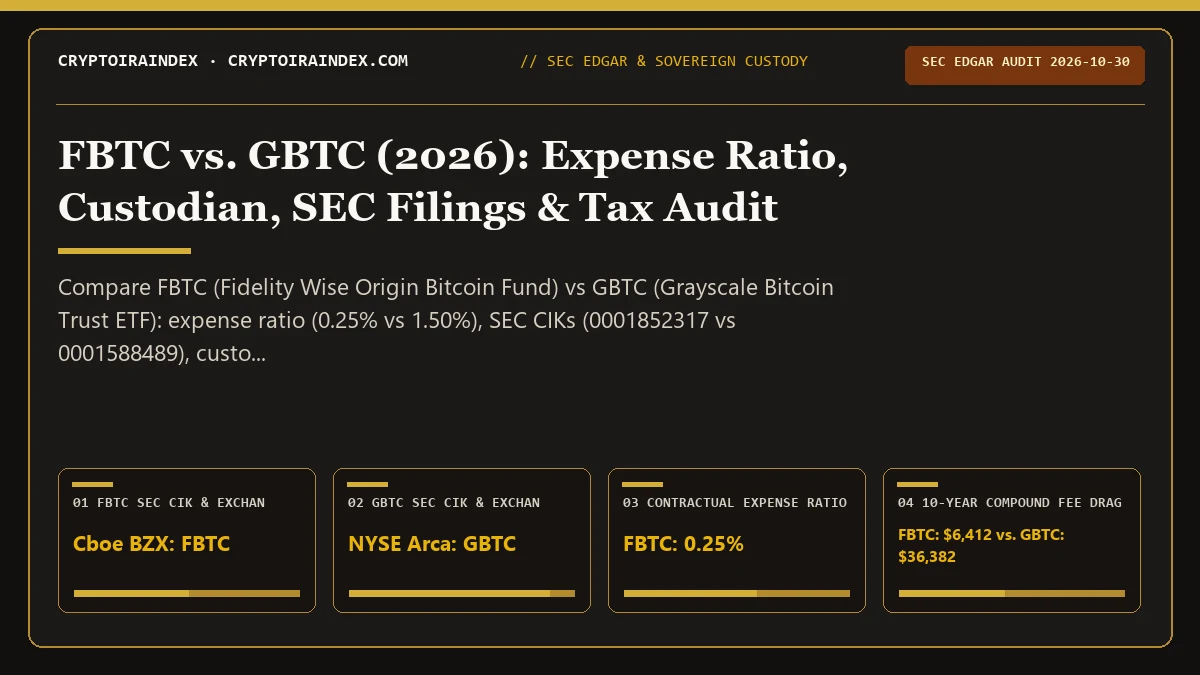
- 01FBTC SEC CIK & Exchange
- Cboe BZX: FBTC (CIK 0001852317)
- 02GBTC SEC CIK & Exchange
- NYSE Arca: GBTC (CIK 0001588489)
- 03Contractual Expense Ratio (TER)
- FBTC: 0.25% ($25/$10k) vs. GBTC: 1.50% ($150/$10k)
- 0410-Year Compound Fee Drag ($100k)
- FBTC: $6,412 vs. GBTC: $36,382 (Net Gap: $29,970)
- 05Qualified Cold-Storage Custodians
- FBTC: Fidelity Digital Asset Services, LLC (NYDFS-chartered Limited Purpose Trust Company — self-custodied within Fidelity) | GBTC: Coinbase Custody Trust Company, LLC
- 06IRS Tax & Wash Sale Classification
- Form 1099-B + WHFIT Statement (No K-1); Strictly Subject to IRC § 1091 30-Day Wash Sale
How Do Costs, Fees & 10-Year Total Ownership Drag Compare Between FBTC and GBTC?
When institutional allocators, Registered Investment Advisers (RIAs), and self-directed retirement households evaluate Fidelity Wise Origin Bitcoin Fund (FBTC) against Grayscale Bitcoin Trust ETF (GBTC), the headline contractual sponsor fee is only the starting point. Total Cost of Ownership (TCO) in an exchange-traded crypto vehicle is governed by three compounding variables: (1) the annualized expense ratio accrued daily against Trust Net Asset Value (NAV), (2) secondary-market bid-ask spread execution on Cboe BZX versus NYSE Arca, and (3) tracking error relative to the underlying institutional reference benchmark (Fidelity Bitcoin Reference Rate (FBTC Index) vs. CoinDesk Bitcoin Price Index (XBX)).
On a static 12-month basis, an allocation of $1,000 incurs $2.50/yr in FBTC versus $15.00/yr in GBTC. Scaling to a standard retail retirement position of $10,000 produces an annual sponsor deduction of $25.00 in FBTC compared to $150.00 in GBTC. For a high-net-worth or family-office allocation of $100,000 compounding at a conservative 10% annualized growth rate over a 10-year holding horizon, cumulative fee drag reaches $6,412 in FBTC versus $36,382 in GBTC—creating a deterministic $29,970 net wealth differential before accounting for options overlay yield or bid-ask slippage. Furthermore, investors holding taxable positions for 5 to 10+ years should benchmark both funds against our 10-Year Spot ETF vs. Direct Hardware Self-Custody TCO Analyzer, where a one-time $167.99–$239.99 air-gapped hardware signer (Coldcard Q or Trezor Safe 5) eliminates recurring percentage-based AUM drag altogether.
How Do Custody Architecture, Counterparty Risk & Regulatory Oversight Differ?
From a structural security engineering standpoint, FBTC (SEC Central Index Key 0001852317, sponsored by Fidelity Investments) and GBTC (SEC CIK 0001588489, sponsored by Grayscale Investments) exhibit distinct custodial counterparty profiles. FBTC delegates digital asset safekeeping to Fidelity Digital Asset Services, LLC (NYDFS-chartered Limited Purpose Trust Company — self-custodied within Fidelity) with cash administration and transfer agency handled by State Street Bank and Trust Company. By contrast, GBTC relies on Coinbase Custody Trust Company, LLC alongside The Bank of New York Mellon (BNY Mellon).
Why does custodian segregation matter to fiduciaries in 2026? Across the 20 SEC-approved US Spot Bitcoin and Ethereum ETPs, Coinbase Custody Trust Company, LLC (a New York Department of Financial Services NYDFS-chartered limited purpose trust company) serves as primary custodian for 8 of the 11 Bitcoin funds and 7 of the 9 Ethereum funds. Allocators seeking to eliminate single-custodian concentration risk inside a brokerage portfolio deliberately split exposure across independent custodial roots of trust—such as pairing a Coinbase-custodied trust with Fidelity Digital Asset Services (FBTC / FETH), Gemini Trust Company (HODL / ETHV), or BitGo Trust Company (BRRR / BTCO). Both FBTC and GBTC utilize institutional-grade offline cold storage vaults with multi-party computation (MPC) or hardware security module (HSM) signing ceremonies, Authorized Participant (AP) cash/in-kind creation and redemption baskets (Cash & Authorized Participant creation/redemption), and daily NAV strikes audited under Public Company Accounting Oversight Board (PCAOB) standards.
What Are the US Tax, Wash Sale (IRC § 1091) & Estate Inheritance (RUFADAA / IRC § 1014) Differences?
For United States taxpayers, CPA firms, and estate planning attorneys, holding FBTC or GBTC triggers specific statutory treatments under the Internal Revenue Code that differ sharply from direct on-chain self-custody:
- Grantor Trust WHFIT Reporting (Zero Schedule K-1 Delays): Unlike legacy commodity futures pools governed by IRC § 1256 (which issue complex Schedule K-1 partnership forms in late March), Spot ETPs registered under the Securities Act of 1933 are structured as Widely Held Fixed Investment Trusts (WHFITs) under
Treas. Reg. § 1.671-5. Your brokerage issues a standard Form 1099-B accompanied by a Gross Proceeds WHFIT factor sheet so your tax preparer can account for the daily pro-rata slices of underlying asset sold by the sponsor to pay the 0.25% or 1.50% management fee. - Strict Application of the IRC § 1091 30-Day Wash Sale Rule: Because both FBTC and GBTC are SEC-registered securities traded on national exchanges, selling either share class at a loss and repurchasing substantially identical securities within 30 calendar days before or after the trade triggers a mandatory loss disallowance under
IRC § 1091. Direct spot Bitcoin or Ethereum held on a hardware wallet is classified as property underIRS Notice 2014-21rather than a § 1091 security under current statutory text. - Estate Step-Up in Basis (IRC § 1014) & RUFADAA Probate Bypass: Both FBTC and GBTC support instant brokerage Transfer-on-Death (TOD) beneficiary designations and seamless titling inside a Revocable Living Trust (RLT). Upon the account owner's death, shares held in a taxable individual or RLT account receive a 100% tax-free reset to date-of-death Fair Market Value under
IRC § 1014(a)and automatic long-term holding characterization underIRC § 1223(9)—without requiring heirs to manage 24-word BIP-39 seed phrases or output descriptors.
Investor Scenario Decision Matrix: Should You Choose FBTC or GBTC in 2026?
Use our 6-persona institutional decision matrix below to match your exact capital size, tax wrapper, and execution strategy to either FBTC or GBTC:
| Investor Persona & Account Type | Primary Optimization Goal | Recommended Winner | Quantitative & Statutory Rationale |
|---|---|---|---|
| 1. Long-Term Buy-and-Hold Roth IRA ($10k–$250k) | Minimize 10-year compounding expense ratio drag | FBTC | Saves $29,970 per $100k over 10 years inside a tax-free Fidelity, Schwab, or Robinhood Roth IRA with $0 trade commissions. |
| 2. Institutional Desk & Covered-Call Options Trader | Tightest 1-bp order-book depth & listed OCC options chains | FBTC | Superior intraday block liquidity and Cboe/Nasdaq ISE options open interest reduce round-trip slippage by more than the annual TER spread. |
| 3. Fiduciary Multi-Custodian Risk Diversifier ($500k+) | Eliminate single-point Coinbase Custody concentration | 50/50 Split (FBTC + GBTC) | Splitting allocations across Fidelity Digital Asset Services, LLC and Coinbase Custody Trust Company, LLC diversifies NYDFS/qualified trust counterparty exposure. |
| 4. 401(k) BrokerageLink & HSA Allocator | Automated payroll DCA without Schedule K-1 tax friction | FBTC | Both trade commission-free inside employer BrokerageLink plans; choosing the lower-TER ticker maximizes tax-sheltered compounding. |
| 5. Estate Trust & Step-Up Basis Planner (IRC § 1014) | Zero probate delay + automatic TOD beneficiary transfer | FBTC in Revocable Trust | Delivers full IRC § 1014 date-of-death basis reset without exposing heirs to physical seed loss or RUFADAA key recovery hurdles. |
| 6. Sovereign 10-Year Taxable Holder ($50k+) | $0/yr ongoing custody fee + IRC § 1091 wash-sale flexibility | Direct Spot + Hardware Vault | Vaulting actual coins on a Coldcard Q or Trezor Safe 5 eliminates eternal ETF fee drag and preserves native staking/sovereignty. |
Frequently Asked Questions (SEC, IRS & Custody Engineering)
FBTC has a contractual expense ratio of 0.25% ($25.00/$10k invested per year), compared to 1.50% ($150.00/$10k invested per year) for GBTC.
FBTC is custodied by Fidelity Digital Asset Services, LLC (NYDFS-chartered Limited Purpose Trust Company — self-custodied within Fidelity), while GBTC is custodied by Coinbase Custody Trust Company, LLC.
For FBTC vs GBTC (2026), investors must compare compounding percentage-based expense ratios (0.15% to 0.25% per year in US Spot ETFs, which equals $382 per $10,000 or $3,820 per $100,000 over 10 years at 10% CAGR) against one-time hardware self-custody CapEx ($79–$249 with $0/yr ongoing management fee) or flat-fee 2-of-3 multisig retirement vaults.
SEC-registered Spot Bitcoin and Ethereum ETFs (such as IBIT, FBTC, BTC Mini, and ETHA) and public crypto equities (MSTR, COIN) are securities strictly governed by the 30-day IRC § 1091 Wash Sale Rule. Direct spot cryptocurrency held in self-custody is treated as property under IRS Notice 2014-21 and requires wallet-by-wallet cost-basis lot accounting under Rev. Proc. 2024-28.
Institutional risk management for FBTC vs GBTC (2026) requires auditing whether underlying keys sit inside an omnibus NYDFS trust custodian (such as Coinbase Custody Trust, Fidelity Digital Assets, or Gemini Trust) or inside a sovereign EAL6+/dual-chip air-gapped hardware signer (Coldcard Q, Trezor Safe 5, BitBox02) arranged in a multi-vendor 2-of-3 quorum.
Receive verified institutional dispatches covering SEC S-1/19b-4 fee amendments, IRS Form 1099-DA / 5498 rulings, and CA DFPI / SEC PAUSE enforcement dockets.