FBTC vs. MSTR (2026): 1:1 Grantor Trust Spot ETF vs. C-Corp Crypto Equity Audit
Structural institutional comparison between Fidelity Wise Origin Bitcoin Fund (FBTC) and Strategy Inc. (formerly MicroStrategy Incorporated — Class A Common Stock) (MSTR). Evaluate 1:1 Grantor Trust Spot ETF fee drag vs. C-Corporation operating leverage, balance-sheet Bitcoin dilution risk, and Form 1099-B tax rules.
Vehicle Structure & Fee Comparison: FBTC carries 0.25% ($25.00/$10k), compared to 0.00% (Direct Corporate Equity) (No ETF Fee (C-Corp Stock)) for MSTR.
Custody & Balance Sheet Profile: FBTC: Fidelity Digital Asset Services, LLC (NYDFS-chartered Limited Purpose Trust Company — self-custodied within Fidelity) vs. MSTR: Coinbase Custody & Fidelity Digital Assets (for corporate BTC treasury holdings).
Side-by-Side SEC & Custodial Specification Matrix: FBTC vs. MSTR
| Specification | FBTC (Fidelity Investments) | MSTR (Strategy Inc. (MicroStrategy Incorporated)) |
|---|---|---|
| Full Legal Name | Fidelity Wise Origin Bitcoin Fund | Strategy Inc. (formerly MicroStrategy Incorporated — Class A Common Stock) |
| Exchange & Ticker | Cboe BZX: FBTC | NASDAQ: MSTR |
| SEC Central Index Key (CIK) | 0001852317 | 0001050446 |
| Primary Sector / Vehicle Type | Spot Crypto ETP (1933 Act Grantor Trust) | Bitcoin Treasury Company & Enterprise Analytics Software |
| Annual Management Fee (TER) | 0.25% ($25.00/$10k) | 0.00% (Direct Corporate Equity) (No ETF Fee (C-Corp Stock)) |
| Custody / Balance Sheet Role | Fidelity Digital Asset Services, LLC (NYDFS-chartered Limited Purpose Trust Company — self-custodied within Fidelity) | Coinbase Custody & Fidelity Digital Assets (for corporate BTC treasury holdings) |
| Benchmark / Index Membership | Fidelity Bitcoin Reference Rate (FBTC Index) | NASDAQ-100 Index (added Dec 2024) |
| Options Availability | Cboe / NASDAQ / NYSE Options | NASDAQ / Cboe / NYSE Options (Weekly & LEAPS) |
| Tax Reporting Structure | Grantor Trust (1933 Securities Act) — Issues Form 1099-B + Annual WHFIT (Widely Held Fixed Investment Trust) Tax Information Statement (No Schedule K-1) | C-Corporation Common Stock — Issues Form 1099-B on sale |
| IRC § 1091 Wash Sale Rule | Subject to IRC § 1091 Wash Sale Rule (regulated exchange-traded security; repurchasing identical or substantially identical ETF shares within 30 days before/after a loss sale disallows the loss deduction) | Subject to IRC § 1091 Wash Sale Rule (Corporate Equity Security) |
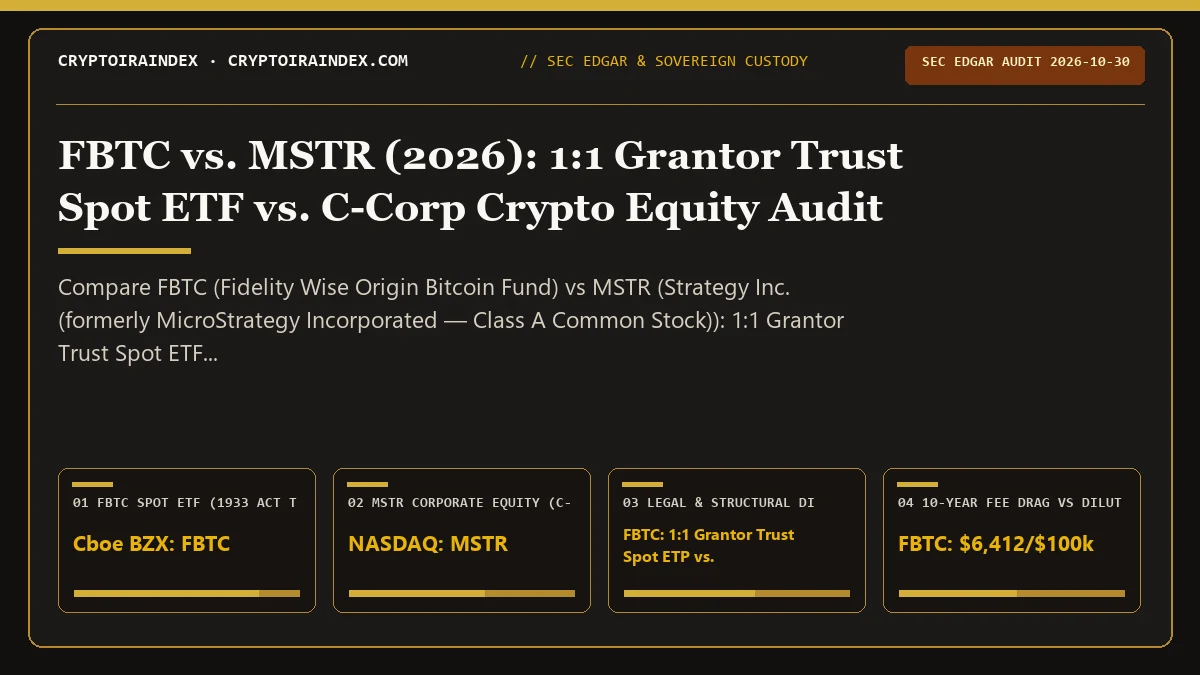
- 01FBTC Spot ETF (1933 Act Trust)
- Cboe BZX: FBTC (CIK 0001852317) · 0.25% TER
- 02MSTR Corporate Equity (C-Corp)
- NASDAQ: MSTR (CIK 0001050446) · 0.00% ETF TER
- 03Legal & Structural Divide
- FBTC: 1:1 Grantor Trust Spot ETP vs. MSTR: Bitcoin Treasury Company & Enterprise Analytics Software
- 0410-Year Fee Drag vs Dilution
- FBTC: $6,412/$100k (0.25% TER) vs. MSTR: $0 ETF Fee (Convertible Debt + ATM BTC Treasury · 2.15x Beta)
- 05Custody & Counterparty Profile
- FBTC: Fidelity Digital Asset Services, LLC (NYDFS-chartered Limited Purpose Trust Company — self-custodied within Fidelity) | MSTR: Coinbase Custody & Fidelity Digital Assets (for corporate BTC treasury holdings)
- 06IRS Tax & Wash Sale Rules
- FBTC: Form 1099-B + WHFIT Statement vs. MSTR: C-Corp Form 1099-B (Both Subject to IRC § 1091)
How Do 1:1 Spot ETF Fee Drag (FBTC) and Corporate Equity Operating Leverage (MSTR) Compare?
Allocating between Fidelity Wise Origin Bitcoin Fund (FBTC) and Strategy Inc. (formerly MicroStrategy Incorporated — Class A Common Stock) (MSTR) is a structural choice between a 1:1 Securities Act of 1933 Grantor Trust Spot ETF and an operating/treasury C-Corporation common stock. FBTC holds physical BTC in segregated institutional cold storage and charges a contractual sponsor expense ratio of 0.25%/yr—costing $2.50/yr on $1,000, $25.00/yr on $10,000, and $6,412 compounded over 10 years on $100,000 (at 10% CAGR).
By contrast, MSTR is a corporate equity that charges 0.00% in ETF sponsor fees, but exposes shareholders to Bitcoin Treasury Company & Enterprise Analytics Software (World's largest corporate holder of Bitcoin, utilizing convertible senior notes, preferred stock (STRK/STRF), and at-the-market equity offerings to accumulate BTC as primary treasury reserve asset.). Instead of a fixed 0.25% annual fee deduction, MSTR investors experience a historical realized beta of 2.15x, equity premium/discount fluctuations relative to net asset value (mNAV), and potential share dilution from convertible debt or at-the-market (ATM) stock issuances.
How Do Custody Architecture, Counterparty Risk & SEC Oversight Differ?
In FBTC (SEC CIK 0001852317), underlying coins are held in statutory trust by Fidelity Digital Asset Services, LLC (NYDFS-chartered Limited Purpose Trust Company — self-custodied within Fidelity) with daily Authorized Participant (AP) cash and in-kind creation/redemption baskets that arbitrage any premium or discount back to 1:1 Net Asset Value. In MSTR (SEC CIK 0001050446), shareholders own common equity sitting junior to corporate creditors, convertible bondholders, and preferred stockholders (Coinbase Custody & Fidelity Digital Assets (for corporate BTC treasury holdings)).
What Are the US Tax, Wash Sale (IRC § 1091) & Estate Inheritance (IRC § 1014) Differences?
- Grantor Trust WHFIT (FBTC) vs. C-Corporation Form 1099-B (MSTR): FBTC is a Widely Held Fixed Investment Trust under
Treas. Reg. § 1.671-5(issuing Form 1099-B + a WHFIT factor sheet for daily TER pro-rata sales), whereas MSTR is a standard C-Corporation issuing a simple Form 1099-B without WHFIT adjustments. Neither issues a Schedule K-1. - IRC § 1091 Wash Sale & Cross-Vehicle Tax-Loss Harvesting: Both FBTC and MSTR are SEC-registered securities subject to the 30-day
IRC § 1091Wash Sale Rule. However, because FBTC (a 1933 Act Grantor Trust) and MSTR (an operating C-Corporation) have different legal issuers and asset structures, institutional desks frequently evaluate cross-vehicle rotation during drawdowns. - Retirement & IRC § 1014 Step-Up: Both qualify for tax-free compounding inside a Roth IRA and receive a 100% date-of-death basis reset under IRC § 1014(a) when held in a taxable account or Revocable Living Trust.
Investor Scenario Decision Matrix: Should You Choose FBTC or MSTR in 2026?
| Investor Persona & Account Type | Primary Optimization Goal | Recommended Winner | Quantitative & Statutory Rationale |
|---|---|---|---|
| 1. Pure 1:1 Spot Bitcoin NAV Allocator ($10k–$500k) | Zero corporate dilution or mNAV premium compression risk | FBTC | AP creation/redemption locks shares 1:1 to spot NAV for a predictable 0.25% ($25/$10k/yr) sponsor fee. |
| 2. High-Beta Leveraged Treasury / Operating Bull | Outperform 1:1 spot via corporate leverage & 0.00% ETF TER | MSTR | Captures 2.15x historical beta and Convertible Debt + ATM BTC Treasury with zero recurring ETF expense ratio. |
| 3. Restricted Brokerage / 401(k) Plan Participant | Bypass Vanguard / employer blocks on Spot Crypto ETPs | MSTR | Trades as standard NASDAQ C-Corp stock (NASDAQ-100 Index (added Dec 2024)) even where 1933 Act crypto ETPs are restricted. |
| 4. Options Volatility & Covered-Call Harvester | Combine tight ETF spreads with high-IV equity premiums | 70% FBTC / 30% MSTR | Pairs core 1:1 spot collateral in FBTC with high-implied-volatility weekly option premium on MSTR. |
| 5. Estate Trust & Step-Up Basis Planner (IRC § 1014) | Predictable 1:1 spot tracking + TOD probate bypass | FBTC in Revocable Trust | Eliminates corporate key-person and balance-sheet risk over multi-decade generational horizons. |
| 6. Sovereign 10-Year Cold-Storage Holder ($50k+) | Eliminate both 0.25% ETF drag and corporate dilution | Direct Spot + Hardware Vault | Self-custody on Coldcard Q or Trezor Safe 5 saves $6,412/$100k over 10 years. |
Frequently Asked Questions (SEC, IRS & Custody Engineering)
Comparing FBTC (0.25%) vs MSTR (0.00% (Direct Corporate Equity)) comes down to vehicle structure: a 1933 Act Grantor Trust Spot ETF tracks underlying coins 1:1 with Authorized Participant arbitrage, whereas a C-Corporation equity carries 0.00% ETF management fee but introduces corporate operating leverage and share dilution risk.
FBTC uses Grantor Trust (1933 Securities Act) — Issues Form 1099-B + Annual WHFIT (Widely Held Fixed Investment Trust) Tax Information Statement (No Schedule K-1), whereas MSTR uses C-Corporation Common Stock — Issues Form 1099-B on sale. Both are exchange-traded securities subject to the IRC § 1091 30-day Wash Sale Rule.
For FBTC vs MSTR (2026), investors must compare compounding percentage-based expense ratios (0.15% to 0.25% per year in US Spot ETFs, which equals $382 per $10,000 or $3,820 per $100,000 over 10 years at 10% CAGR) against one-time hardware self-custody CapEx ($79–$249 with $0/yr ongoing management fee) or flat-fee 2-of-3 multisig retirement vaults.
SEC-registered Spot Bitcoin and Ethereum ETFs (such as IBIT, FBTC, BTC Mini, and ETHA) and public crypto equities (MSTR, COIN) are securities strictly governed by the 30-day IRC § 1091 Wash Sale Rule. Direct spot cryptocurrency held in self-custody is treated as property under IRS Notice 2014-21 and requires wallet-by-wallet cost-basis lot accounting under Rev. Proc. 2024-28.
Institutional risk management for FBTC vs MSTR (2026) requires auditing whether underlying keys sit inside an omnibus NYDFS trust custodian (such as Coinbase Custody Trust, Fidelity Digital Assets, or Gemini Trust) or inside a sovereign EAL6+/dual-chip air-gapped hardware signer (Coldcard Q, Trezor Safe 5, BitBox02) arranged in a multi-vendor 2-of-3 quorum.
Receive verified institutional dispatches covering SEC S-1/19b-4 fee amendments, IRS Form 1099-DA / 5498 rulings, and CA DFPI / SEC PAUSE enforcement dockets.