MARA vs. RIOT (2026): Corporate Crypto Model, Balance Sheet BTC & Tax Audit
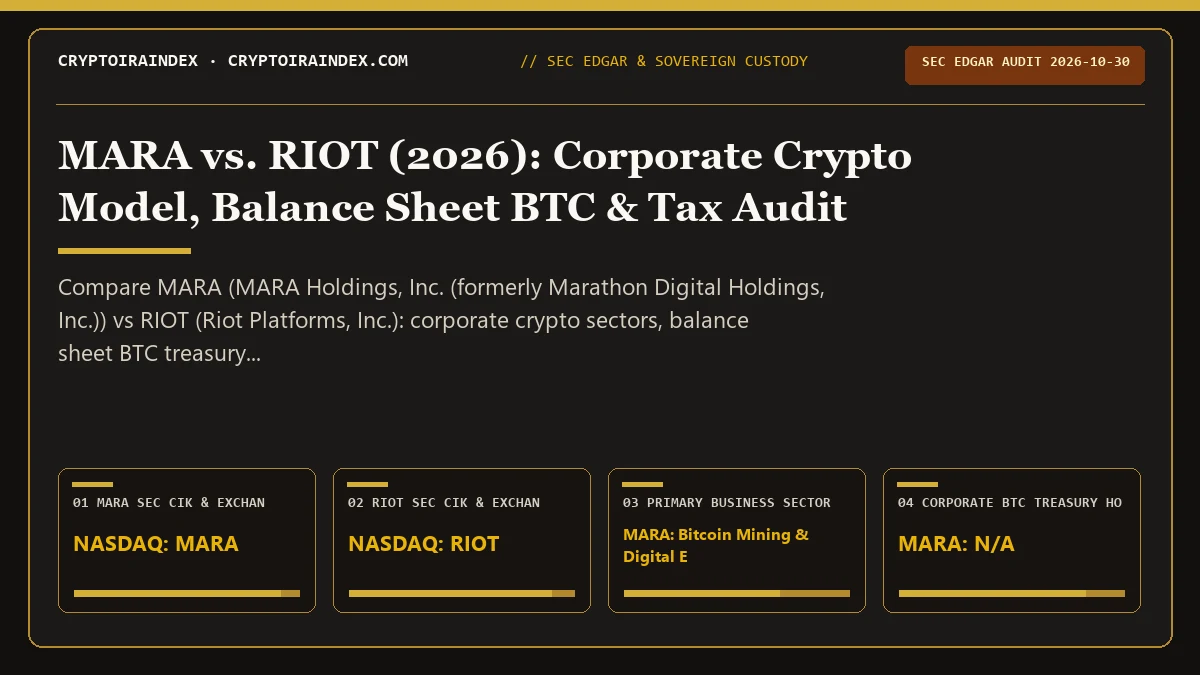
Head-to-head institutional equity comparison between MARA Holdings, Inc. (formerly Marathon Digital Holdings, Inc.) (MARA) and Riot Platforms, Inc. (RIOT). Compare primary crypto business models (Bitcoin Mining & Digital Energy Infrastructure vs. Bitcoin Mining & Vertically Integrated Data Center Infrastructure), balance-sheet Bitcoin holdings, options liquidity, and IRC § 1091 C-Corporation tax rules.
Corporate Sector & Fee Structure: Both MARA and RIOT are SEC-reporting C-Corporation stocks with 0.00% ETF management fee (no Grantor Trust TER drag).
Operating Exposure: MARA focuses on Bitcoin Mining & Digital Energy Infrastructure (N/A (Corporate Equity — holds mined & purchased BTC on corporate balance sheet)), whereas RIOT focuses on Bitcoin Mining & Vertically Integrated Data Center Infrastructure (N/A (Corporate Equity)).
Side-by-Side SEC & Custodial Specification Matrix: MARA vs. RIOT
| Specification | MARA (MARA Holdings, Inc.) | RIOT (Riot Platforms, Inc.) |
|---|---|---|
| Full Legal Name | MARA Holdings, Inc. (formerly Marathon Digital Holdings, Inc.) | Riot Platforms, Inc. |
| Exchange & Ticker | NASDAQ: MARA | NASDAQ: RIOT |
| SEC Central Index Key (CIK) | 0001507605 | 0001167419 |
| Primary Sector / Vehicle Type | Bitcoin Mining & Digital Energy Infrastructure | Bitcoin Mining & Vertically Integrated Data Center Infrastructure |
| Annual Management Fee (TER) | 0.00% (Direct Corporate Equity) (No ETF Fee (C-Corp Stock)) | 0.00% (Direct Corporate Equity) (No ETF Fee (C-Corp Stock)) |
| Custody / Balance Sheet Role | N/A (Corporate Equity — holds mined & purchased BTC on corporate balance sheet) | N/A (Corporate Equity) |
| Benchmark / Index Membership | S&P SmallCap 600 / Russell 2000 | Russell 2000 |
| Options Availability | NASDAQ / Cboe Options | NASDAQ / Cboe Options |
| Tax Reporting Structure | C-Corporation Common Stock — Issues Form 1099-B on sale | C-Corporation Common Stock — Issues Form 1099-B on sale |
| IRC § 1091 Wash Sale Rule | Subject to IRC § 1091 Wash Sale Rule (Corporate Equity Security) | Subject to IRC § 1091 Wash Sale Rule (Corporate Equity Security) |
- 01MARA SEC CIK & Exchange
- NASDAQ: MARA (CIK 0001507605)
- 02RIOT SEC CIK & Exchange
- NASDAQ: RIOT (CIK 0001167419)
- 03Primary Business Sector
- MARA: Bitcoin Mining & Digital Energy Infrastructure | RIOT: Bitcoin Mining & Vertically Integrated Data Center Infrastructure
- 04Corporate BTC Treasury Holdings
- MARA: N/A (Corporate Equity — holds mined & purchased BTC on corporate balance sheet) | RIOT: N/A (Corporate Equity)
- 05Annual Management Fee (TER)
- 0.00% (Direct Corporate Equity — No ETF Sponsor Fee)
- 06Key Operating Driver & Risk
- MARA: Energized Hashrate + Mined BTC Hold (1.95x BTC Beta) vs. RIOT: Texas Power Credits + Mining Capacity (1.88x BTC Beta)
- 07IRS Tax Classification
- Form 1099-B (C-Corp Equity Capital Gains · Subject to IRC § 1091 Wash Sale)
How Do Corporate Business Models, Balance Sheet BTC Holdings & Equity Dilution Risk Compare Between MARA and RIOT?
Unlike 1933 Act Grantor Trust Spot ETFs (which passively hold a fixed pool of Bitcoin or Ether and deduct an annual sponsor expense ratio), MARA Holdings, Inc. (formerly Marathon Digital Holdings, Inc.) (MARA) and Riot Platforms, Inc. (RIOT) are operating C-Corporation equities registered with the U.S. Securities and Exchange Commission. Neither MARA nor RIOT charges an ETF management fee (0.00% TER on a $1,000, $10,000, or $100,000 stock position). Instead, shareholder returns are governed by corporate cash flows, balance-sheet Bitcoin treasury accumulation, operating leverage, and capital-structure dilution (convertible senior notes, at-the-market equity offerings, and employee stock-based compensation).
Specifically, MARA operates in Bitcoin Mining & Digital Energy Infrastructure (Largest publicly traded US Bitcoin mining company by energized hash rate and second-largest corporate Bitcoin treasury holder after Strategy (MSTR).), exhibiting a historical realized beta of approximately 1.95x relative to spot Bitcoin. Conversely, RIOT operates in Bitcoin Mining & Vertically Integrated Data Center Infrastructure (Operates large-scale Bitcoin mining and HPC data center facilities in Rockdale and Corsicana, Texas, plus Kentucky operations (acquired via Block Mining).), carrying a realized beta near 1.88x. On a $10,000 or $100,000 institutional allocation, choosing between MARA and RIOT is a structural decision between Energized Hashrate + Mined BTC Hold and Texas Power Credits + Mining Capacity—and both should be benchmarked against 1:1 unlevered Spot ETFs (IBIT at 0.25% TER or BTC Mini at 0.15% TER) and $0/yr air-gapped hardware self-custody.
How Do Balance Sheet Custody, Counterparty Risk & SEC Form 10-K Oversight Differ?
Both MARA (SEC CIK 0001507605, traded on NASDAQ) and RIOT (SEC CIK 0001167419, traded on NASDAQ) file audited annual Form 10-K, quarterly Form 10-Q, and current Form 8-K disclosures under the Securities Exchange Act of 1934, subject to PCAOB audit oversight and FASB ASU 2023-08 fair-value crypto accounting rules.
However, shareholders in MARA and RIOT hold unsecured corporate common stock rather than a segregated 1:1 Grantor Trust claim on underlying coins. MARA's custodial and treasury footprint is defined by N/A (Corporate Equity — holds mined & purchased BTC on corporate balance sheet) (indexed in S&P SmallCap 600 / Russell 2000), whereas RIOT's corporate structure is defined by N/A (Corporate Equity) (indexed in Russell 2000). If an operating crypto corporation experiences regulatory enforcement, mining power-cost spikes, exchange fee compression, or convertible debt refinancing stress, its equity price can decouple sharply from spot BTC/ETH NAV.
What Are the US Tax, Wash Sale (IRC § 1091) & Retirement / Estate (IRC § 408 / § 1014) Rules?
For US investors, CPAs, and retirement fiduciaries, holding C-Corporation shares in MARA or RIOT carries distinct tax and retirement characteristics:
- Clean Form 1099-B Equity Reporting (No WHFIT Worksheet / No Schedule K-1): Because MARA and RIOT are standard C-Corporations rather than Grantor Trusts, brokerages issue a simple Form 1099-B upon sale without requiring daily WHFIT expense-ratio basis adjustments.
- Strict IRC § 1091 30-Day Wash Sale Enforcement: As exchange-listed corporate stocks, both MARA and RIOT are strictly governed by
IRC § 1091. Selling MARA or RIOT at a loss and repurchasing the same stock (or call options) within 30 days disallows the tax loss—though rotating between MARA, RIOT, and IBIT involves distinct legal issuers and business models. - Universal IRA, 401(k) & IRC § 1014 Step-Up Eligibility: Even at brokerages that restrict Spot Crypto ETPs, MARA and RIOT trade as standard US equities inside Roth IRAs, Traditional IRAs, 401(k) BrokerageLink accounts, and Revocable Living Trusts (qualifying for a 100% tax-free basis reset at death under IRC § 1014(a)).
Investor Scenario Decision Matrix: Should You Choose MARA or RIOT in 2026?
| Investor Persona & Account Type | Primary Optimization Goal | Recommended Winner | Corporate & Statutory Rationale |
|---|---|---|---|
| 1. High-Beta Bitcoin Treasury & Leverage Seeker | Maximize upside torque during Bitcoin bull cycles | MARA | Delivers higher historical BTC beta (1.95x) and direct balance-sheet/operating torque with 0.00% ETF management fee. |
| 2. Diversified Crypto Infrastructure & Revenue Allocator | Capture trading, custody, stablecoin or fintech cash flows | RIOT | Provides broader operating revenue diversification (Texas Power Credits + Mining Capacity) beyond pure spot BTC price action. |
| 3. Covered-Call & Cash-Secured Put Options Trader | Harvest high implied-volatility weekly & LEAPS option premium | MARA + RIOT | Both offer deep weekly and LEAPS options chains on NASDAQ / Cboe Options, ideal for tax-sheltered Roth IRA premium harvesting. |
| 4. Restricted 401(k) / Brokerage Account Holder | Gain crypto exposure where Spot ETPs are blocked | 50/50 Equity Basket | Trades as standard C-Corp common stock (S&P SmallCap 600 / Russell 2000) on any US retirement platform with $0 commissions. |
| 5. Pure 1:1 Spot NAV Tracker (Zero Dilution Risk) | Eliminate corporate debt, management & share dilution risk | IBIT / FBTC / BTC Mini | A 1933 Act Grantor Trust ETF (BTC Mini 0.15% or IBIT 0.25%) tracks spot 1:1 without equity dilution. |
| 6. Sovereign 10-Year Cold-Storage Holder ($50k+) | Eliminate all corporate, SEC & custodian counterparty risk | Direct BTC on Coldcard Q / Trezor | Self-custody on Coldcard Q or Trezor Safe 5 carries $0/yr fee and zero corporate insolvency risk. |
Frequently Asked Questions (SEC, IRS & Custody Engineering)
MARA (MARA Holdings, Inc. (formerly Marathon Digital Holdings, Inc.)) operates in Bitcoin Mining & Digital Energy Infrastructure (Largest publicly traded US Bitcoin mining company by energized hash rate and second-largest corporate Bitcoin treasury holder after Strategy (MSTR).), whereas RIOT (Riot Platforms, Inc.) operates in Bitcoin Mining & Vertically Integrated Data Center Infrastructure (Operates large-scale Bitcoin mining and HPC data center facilities in Rockdale and Corsicana, Texas, plus Kentucky operations (acquired via Block Mining).). Both are C-Corporation equities with 0.00% ETF management fee.
Unlike 1933 Act Grantor Trust Spot ETFs (which issue Form 1099-B plus a WHFIT statement), MARA and RIOT are C-Corporation common stocks that issue standard Form 1099-B capital gains statements and are subject to the IRC § 1091 30-day Wash Sale Rule.
For MARA vs RIOT (2026), investors must compare compounding percentage-based expense ratios (0.15% to 0.25% per year in US Spot ETFs, which equals $382 per $10,000 or $3,820 per $100,000 over 10 years at 10% CAGR) against one-time hardware self-custody CapEx ($79–$249 with $0/yr ongoing management fee) or flat-fee 2-of-3 multisig retirement vaults.
SEC-registered Spot Bitcoin and Ethereum ETFs (such as IBIT, FBTC, BTC Mini, and ETHA) and public crypto equities (MSTR, COIN) are securities strictly governed by the 30-day IRC § 1091 Wash Sale Rule. Direct spot cryptocurrency held in self-custody is treated as property under IRS Notice 2014-21 and requires wallet-by-wallet cost-basis lot accounting under Rev. Proc. 2024-28.
Institutional risk management for MARA vs RIOT (2026) requires auditing whether underlying keys sit inside an omnibus NYDFS trust custodian (such as Coinbase Custody Trust, Fidelity Digital Assets, or Gemini Trust) or inside a sovereign EAL6+/dual-chip air-gapped hardware signer (Coldcard Q, Trezor Safe 5, BitBox02) arranged in a multi-vendor 2-of-3 quorum.
Receive verified institutional dispatches covering SEC S-1/19b-4 fee amendments, IRS Form 1099-DA / 5498 rulings, and CA DFPI / SEC PAUSE enforcement dockets.