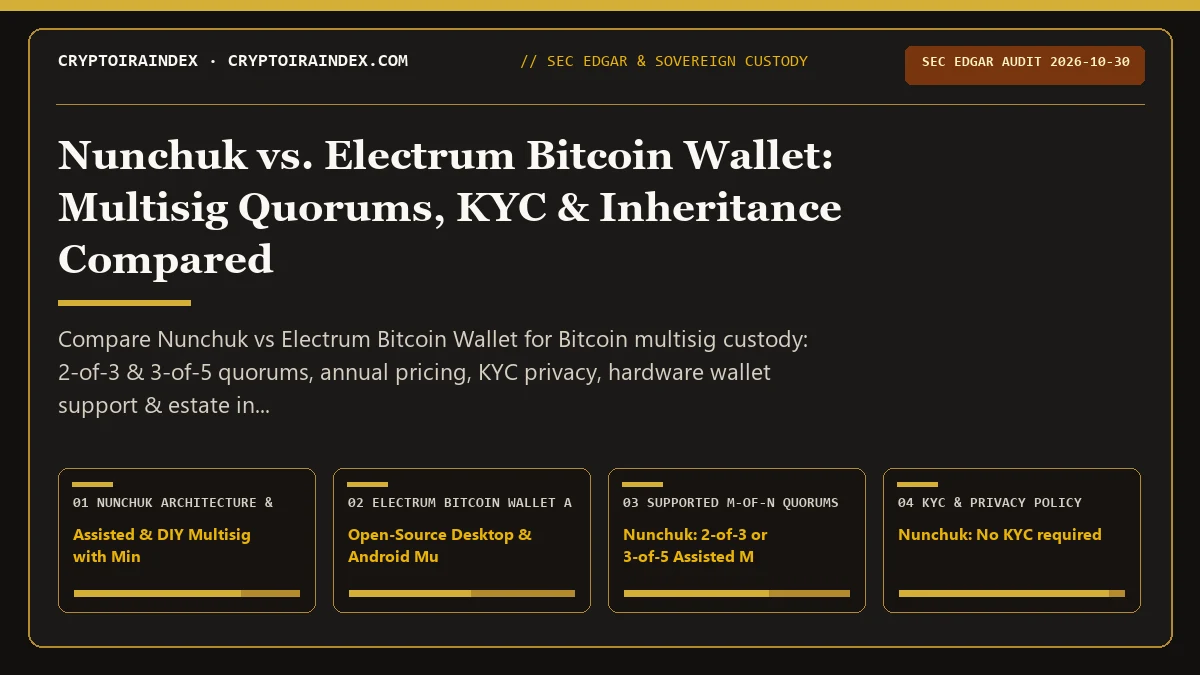
Nunchuk vs. Electrum Bitcoin Wallet: Multisig Quorums, KYC & Inheritance Compared
Architectural comparison between Nunchuk (Assisted & DIY Multisig with Miniscript Timelock Inheritance) and Electrum Bitcoin Wallet (Open-Source Desktop & Android Multisig Coordinator).
Side-by-Side Multisig Specification Table: Nunchuk vs. Electrum Bitcoin Wallet
| Multisig Dimension | Nunchuk | Electrum Bitcoin Wallet |
|---|---|---|
| Coordinator Type | Assisted & DIY Multisig with Miniscript Timelock Inheritance | Open-Source Desktop & Android Multisig Coordinator |
| Quorum Topologies | 2-of-3 or 3-of-5 Assisted Multisig; Custom M-of-N DIY Multisig; Taproot Miniscript Timelock Decay Wallets | Single-Sig; M-of-N Multisig (up to 15 cosigners); 2FA TrustedCoin Multisig |
| Annual Cost | Free (unlimited DIY multisig & group wallets); $120 / year (Iron Hand assisted key); $480–$990 / year (Honey Badger & Byzantine inheritance/family plans) | Free & 100% Open-Source (MIT License) |
| KYC Required? | No KYC required (accepts anonymous Bitcoin Lightning/on-chain subscription payments) | None |
| Supported Assets | Bitcoin-Only (BTC) | Bitcoin-Only (BTC — On-Chain & Lightning Network) |
| Estate Inheritance | Supports both off-chain Assisted Inheritance (Encrypted Inheritance Plan + platform key release after inactivity timer) AND trustless on-chain Bitcoin Miniscript timelocks. | Supports offline cold signing, nLockTime pre-signed raw transactions, and encrypted Cosigner Pool relay. |
- 01Nunchuk Architecture & Pricing
- Assisted & DIY Multisig with Miniscript Timelock Inheritance · Free (unlimited DIY multisig & group wallets); $120 / year (Iron Hand assisted key); $480–$990 / year (Honey Badger & Byzantine inheritance/family plans)
- 02Electrum Bitcoin Wallet Architecture & Pricing
- Open-Source Desktop & Android Multisig Coordinator · Free & 100% Open-Source (MIT License)
- 03Supported M-of-N Quorums
- Nunchuk: 2-of-3 or 3-of-5 Assisted Multisig; Custom M-of-N DIY Multisig; Taproot Miniscript Timelock Decay Wallets | Electrum Bitcoin Wallet: Single-Sig; M-of-N Multisig (up to 15 cosigners); 2FA TrustedCoin Multisig
- 04KYC & Privacy Policy
- Nunchuk: No KYC required (accepts anonymous Bitcoin Lightning/on-chain subscription payments) | Electrum Bitcoin Wallet: None
- 05Hardware Signer Compatibility
- Nunchuk: Coldcard Mk4 / Q (NFC & SD), Trezor, Ledger, BitBox02, Foundation Passport (QR) | Electrum Bitcoin Wallet: Coldcard, Trezor, Ledger, BitBox02, Blockstream Jade
- 06Estate & Timelock Inheritance
- Nunchuk: Supports both off-chain Assisted Inheritance (Encrypted Inheritance Plan + platform k | Electrum Bitcoin Wallet: Supports offline cold signing, nLockTime pre-signed raw transactions, and encrypted C
How Do Costs, Fees & 10-Year Total Ownership Drag Compare Between Nunchuk and Electrum Bitcoin Wallet?
When comparing Nunchuk against Electrum Bitcoin Wallet across a 10-year self-custody horizon, investors shift from recurring percentage-based AUM fees (like the 0.15%–0.25%/yr charged by Spot ETFs) to fixed capital expenditure (CapEx) plus on-chain Bitcoin network miner fees (`sat/vB`). On a $1,000 portfolio, purchasing Nunchuk ($0.00 upfront) or Electrum Bitcoin Wallet ($0.00 upfront) plus a $39 stamped 316 marine stainless steel seed backup represents a one-time setup cost, with $0.00/yr in ongoing management drag. On a $10,000 allocation held for 10 years at 10% CAGR, a 0.25% Spot ETF drains $615 in compounding sponsor fees, whereas both Nunchuk and Electrum Bitcoin Wallet charge $0 in percentage AUM fees. Scaling to a $100,000 sovereign vault over 10 years, self-custody saves $6,150+ in avoided ETF management fees (or $38,200+ on a $500,000 treasury), even when factoring in a multi-vendor 2-of-3 quorum or collaborative inheritance subscription.
Beyond hardware acquisition cost, long-term total cost of ownership depends on Bitcoin script weight and UTXO management. Both Nunchuk and Electrum Bitcoin Wallet support Native SegWit (`P2WPKH`, BIP-84, ~68 vBytes per input) and Taproot (`P2TR`, BIP-86, ~57.5 vBytes per input), while a 2-of-3 multisig input (`P2WSH` / `P2TR` script path) consumes ~105 vBytes. Using our Live Bitcoin UTXO Consolidation Calculator, consolidating small DCA inputs when mempool rates sit at 2–5 sat/vB (<$1.00 per transaction) prevents paying $100+ in network fees during bull-market mempool spikes.
How Do Custody Architecture, Counterparty Risk & Regulatory Oversight Differ?
From a cryptographic hardware and threat-modeling standpoint, Nunchuk and Electrum Bitcoin Wallet take distinct approaches to isolating private keys from internet-connected host malware, supply-chain interdiction, and physical laboratory extraction (voltage glitching, laser fault injection, and differential power analysis). By removing third-party omnibus custodians entirely, self-custody eliminates the counterparty insolvency risk that caused $21.19 billion in historical losses across 1,328 incidents tracked in our Crypto Hacks & CEX Exploits Database and landmark collapses like FTX, Celsius, and Voyager.
Even more importantly, institutional security engineers never treat Nunchuk and Electrum Bitcoin Wallet as mutually exclusive: in a 2-of-3 multi-vendor multisig vault coordinated via Sparrow Wallet, Unchained, Casa, or Nunchuk, combining independent hardware architectures (for example, pairing an air-gapped QR/MicroSD signer with an open-source EAL6+ signer from a second manufacturer) ensures that no single chip vulnerability, supply-chain defect, or firmware bug can ever compromise or freeze your vault.
What Are the US Tax, Wash Sale (IRC § 1091) & Estate Inheritance (RUFADAA / IRC § 1014) Differences?
Holding digital assets directly via Nunchuk or Electrum Bitcoin Wallet unlocks three critical US statutory advantages—and imposes two mandatory compliance responsibilities—under IRS and state fiduciary law:
- IRS Notice 2014-21 Property Status vs. IRC § 1091 Wash Sales: Direct spot Bitcoin and Ethereum held in self-custody are classified as property under
IRS Notice 2014-21, not securities underIRC § 1091, giving taxable self-custody holders flexibility during tax-loss harvesting that Spot ETFs (`IBIT`/`FBTC`/`ETHA`) lack. - Rev. Proc. 2024-28 Wallet-by-Wallet Cost Basis Tracking: Starting January 1, 2025, the IRS eliminated universal cross-wallet pooling. Under
Rev. Proc. 2024-28andTreas. Reg. § 1.1012-1(j), taxpayers must maintain specific unit allocations and cost-basis lots separately for each hardware wallet or multisig vault, while self-to-self UTXO consolidations remain non-taxable transfers of principal. - RUFADAA Estate Succession & IRC § 1014 Step-Up in Basis: When self-custodied crypto is titled inside a Revocable Living Trust (RLT) with explicit RUFADAA fiduciary authorization and a documented Letter of Instruction (or Miniscript timelock / collaborative 2-of-3 inheritance protocol), heirs bypass public probate court and receive a 100% tax-free step-up in cost basis to date-of-death Fair Market Value under IRC § 1014(a).
Investor Scenario Decision Matrix: Should You Choose Nunchuk or Electrum Bitcoin Wallet in 2026?
| Self-Custody Persona & Threat Model | Primary Engineering Requirement | Recommended Winner | Technical & Operational Rationale |
|---|---|---|---|
| 1. Air-Gapped Cold Vault Maximalist ($50k–$1M+) | Zero physical USB data connection to host PC | Nunchuk | Optical QR (`BBQr`/`UR 2.0`) or MicroSD PSBT signing isolates private keys completely from host OS malware and USB stack exploits. |
| 2. 2-of-3 Multi-Vendor Quorum Architect | Eliminate single-vendor silicon & firmware monoculture | Combine Both (Nunchuk + Electrum Bitcoin Wallet) | Using Nunchuk as Key 1 and Electrum Bitcoin Wallet as Key 2 inside Sparrow Wallet guarantees zero single point of failure. |
| 3. Cost-Conscious DCA Accumulator ($1k–$25k) | Maximum cryptographic security per dollar of CapEx | Nunchuk | Delivers institutional-grade key isolation at the lower upfront acquisition cost, leaving more capital for spot accumulation. |
| 4. Estate & RUFADAA Trust Executor Setup | Guided heir recovery without exposing live seed phrases | Nunchuk in 2-of-3 Vault | Pairs cleanly with a Revocable Living Trust and BIP-380 Output Descriptor backups for seamless IRC § 1014 transfer. |
| 5. Collaborative 2-of-3 Multisig IRA Holder | McNulty-compliant retirement key control (IRC § 408) | Nunchuk + Electrum Bitcoin Wallet | Both serve as verified hardware cosigners inside Unchained IRA and Choice by Kingdom Trust retirement vaults. |
| 6. Active Web3 / Multi-Chain DeFi Operator | Strict Tier-1 Cold Vault vs Tier-2 Hot Wallet separation | 2-Device Tiered Segregation | Keep 95% of net worth on a zero-approval cold signer (Zero Permit2 exposure) and use a separate signer for active DeFi. |
Frequently Asked Questions (SEC, IRS & Custody Engineering)
Nunchuk (Free (unlimited DIY multisig & group wallets); $120 / year (Iron Hand assisted key); $480–$990 / year (Honey Badger & Byzantine inheritance/family plans)) offers 2-of-3 or 3-of-5 Assisted Multisig; Custom M-of-N DIY Multisig; Taproot Miniscript Timelock Decay Wallets, whereas Electrum Bitcoin Wallet (Free & 100% Open-Source (MIT License)) offers Single-Sig; M-of-N Multisig (up to 15 cosigners); 2FA TrustedCoin Multisig.
For Nunchuk vs Electrum Bitcoin Wallet, investors must compare compounding percentage-based expense ratios (0.15% to 0.25% per year in US Spot ETFs, which equals $382 per $10,000 or $3,820 per $100,000 over 10 years at 10% CAGR) against one-time hardware self-custody CapEx ($79–$249 with $0/yr ongoing management fee) or flat-fee 2-of-3 multisig retirement vaults.
SEC-registered Spot Bitcoin and Ethereum ETFs (such as IBIT, FBTC, BTC Mini, and ETHA) and public crypto equities (MSTR, COIN) are securities strictly governed by the 30-day IRC § 1091 Wash Sale Rule. Direct spot cryptocurrency held in self-custody is treated as property under IRS Notice 2014-21 and requires wallet-by-wallet cost-basis lot accounting under Rev. Proc. 2024-28.
Institutional risk management for Nunchuk vs Electrum Bitcoin Wallet requires auditing whether underlying keys sit inside an omnibus NYDFS trust custodian (such as Coinbase Custody Trust, Fidelity Digital Assets, or Gemini Trust) or inside a sovereign EAL6+/dual-chip air-gapped hardware signer (Coldcard Q, Trezor Safe 5, BitBox02) arranged in a multi-vendor 2-of-3 quorum.
Assets held in a taxable brokerage account or titled inside a Revocable Living Trust (RLT) receive a 100% step-up in cost basis to Fair Market Value on the date of death under IRC § 1014(a) and automatic long-term capital gain treatment under IRC § 1223(9). Self-custody holders should pair an RLT with RUFADAA fiduciary clauses and a separate cryptographic Letter of Instruction.
Receive verified institutional dispatches covering SEC S-1/19b-4 fee amendments, IRS Form 1099-DA / 5498 rulings, and CA DFPI / SEC PAUSE enforcement dockets.